NixOS options
Every NixOS option there is — about 25,500 of them, including over 2,000
services.*.enable. This is how you reach a service the curated catalogue
does not carry, which is most of them.
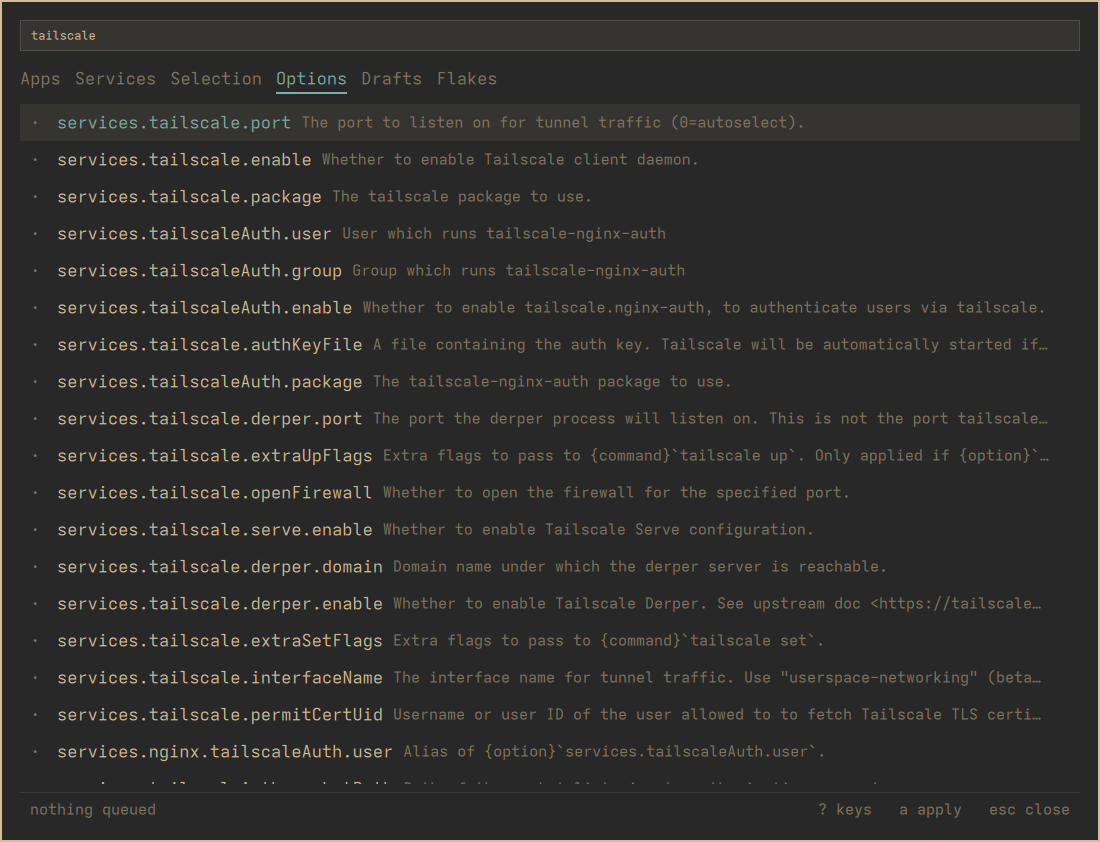
/ searches. Each row shows the option’s path and its type, read from
nixpkgs’ own options.json rather than guessed.
Setting one
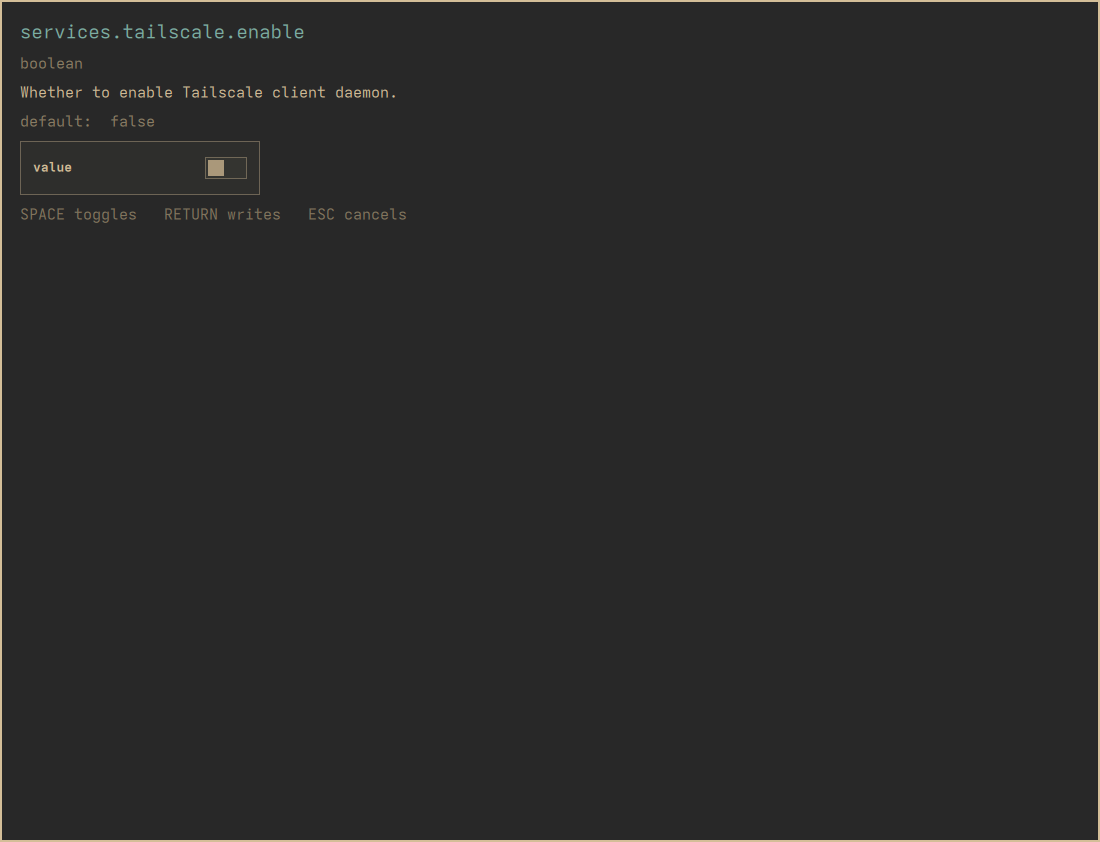
RETURN opens a form built from the option’s declared type. Not a text box
with a label — an actual widget, when the type admits one.
| Type | What you get |
|---|---|
boolean |
A checkbox. SPACE flips it |
| enum | The alternatives, j/k to choose |
int |
A number field |
| simple string / path | A text field |
| anything else | See below |
The type, the documentation and the default are all shown. RETURN writes,
ESCAPE cancels.
An untouched field writes nothing
This is the rule worth internalising, and it is deliberate.
The value the form shows you is the default — or, when the option is
already set, the value in apps.nix, labelled set in apps.nix. If you
leave it alone and
press RETURN, nothing is written — because the default is already in force,
and a copied-out default is a line that reads like a decision and is not
one. Six months later you cannot tell which of your option lines you meant
and which the form put there.
So: change it, or cancel. Both are honest. Writing out what was already true is not.
Why some options get a comment instead of a widget
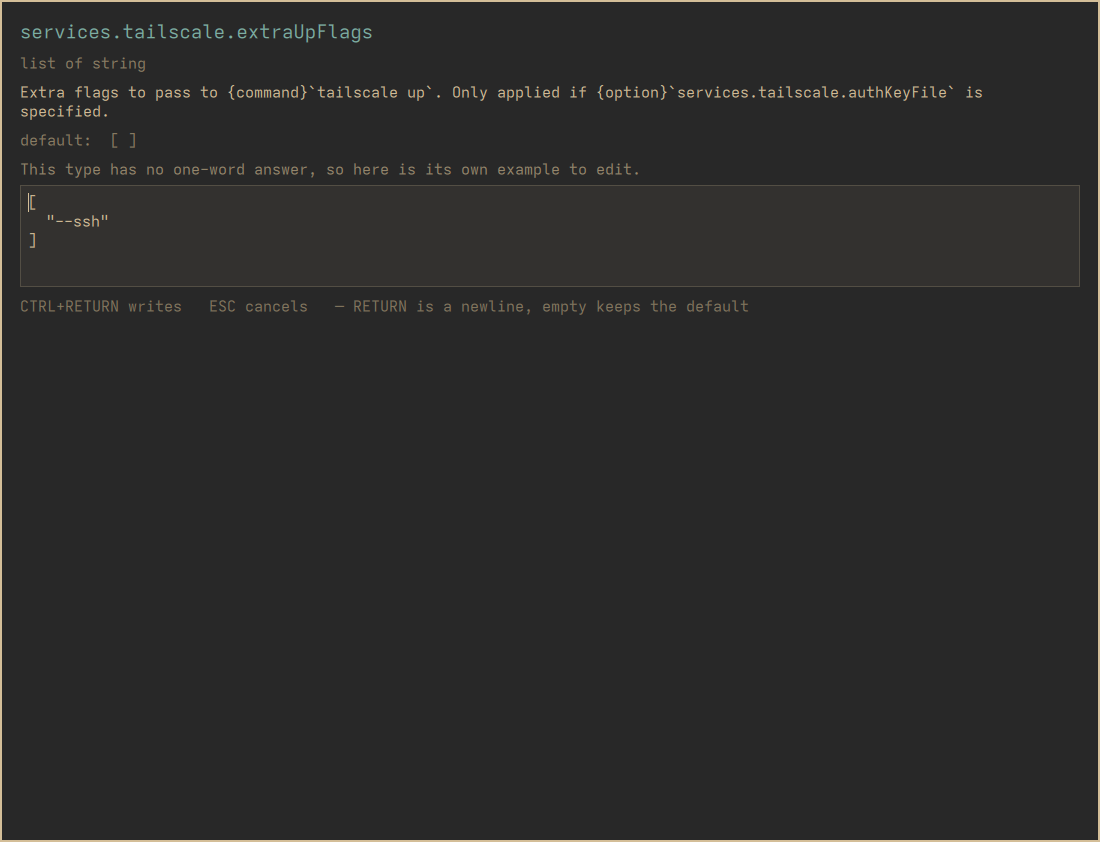
Booleans, enums, integers and simple strings get a real widget. Lists,
null or T, attribute sets, submodules and functions do not.
They get the option’s own example — or its default — written commented out, with its type and documentation beside it, as a starting shape for you to edit.
That is not the form giving up. A widget for “a list of submodules” would be a text box pretending to understand Nix, and the first thing it would do is let you write something that parses and means the wrong thing. An honest scaffold with the real example in it gets you further than a dishonest widget.
The writer runs a parse check either way, so a value that would leave the file unparseable is refused and nothing is changed — and the message you get is nix’s own words rather than a guess at them.
Changing one
RETURN on an option that is already set opens the form on its value.
Change it and press RETURN, and the line is replaced where it stands, in one
step that either changes it or leaves the file exactly as it was. A value the
widget cannot hold exactly — lib.mkDefault true, an expression — opens as its
own text to edit.
Removing one
SPACE on an option row that is already set removes it. The option reverts
to its default, which is what it was before you touched it.