AIFactory

AIFactory
Spec-Driven Development for AI agents — plan, code, ship.





Docs · Demo · Architecture · Roadmap · Contributing
📖 New here? Start at the docs → aifactory.freundcloud.com — guided demo, screenshots, architecture, and the full getting-started guide.
What it is
AIFactory turns GitHub issues into shipping code via a coordinated planner / coder / QA agent pipeline. You bring an issue (or a one-line task description) — AIFactory writes a spec, plans the work, codes it in an isolated git worktree, validates against the spec’s acceptance criteria, and hands you back a merge-ready branch.
You watch the whole thing happen live in the Agent Console — read-only by default, one-click Attach when you want to drive — or open the task in Mission Control, a full-page three-pane workspace (plan · live activity + console · preview / files / review). See docs/docs/concepts/mission-control-workspace.md.
🚀 What’s new (May 2026) — three more epics closed on top of the May MCP shipset:
- Delegation (#92) — hand the coder phase off to GitHub Copilot Coding Agent or GitLab Duo Workflow while AIFactory keeps the planning + governance. Hybrid only: planner runs on Claude, the structured plan lands as a comment on the issue, then the provider’s agent codes. See
docs/docs/concepts/delegation.md.- Portal-managed Git clones (#82) — point the portal at a Git URL, it clones into a workspace root (laptop default
~/.aifactory/workspaces/, Helm-templated PVC on K8s). Stored Personal Access Tokens encrypted at rest. Required for SaaS / Kubernetes deployments. Seedocs/docs/concepts/portal-clones.md.- Scoped MCP API keys (#154) — replace the host-wide admin token at
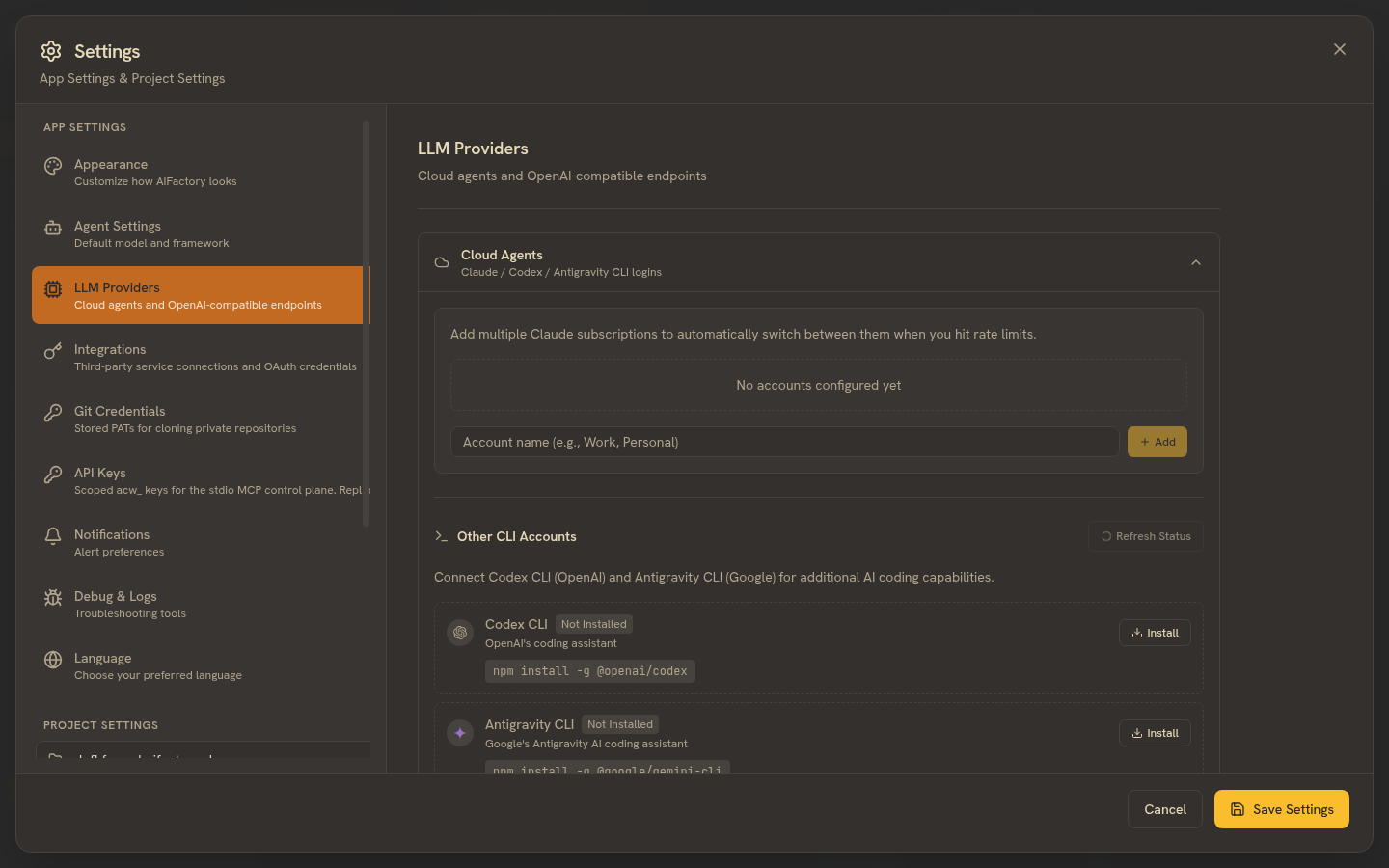
~/.aifactory/.tokenwith per-developer scope-gatedacw_keys. Mint via Settings → API Keys, drop in$AIFACTORY_MCP_KEY, done. Legacy admin token still works as a wildcard fallback. Seedocs/docs/concepts/mcp-stdio-keys.md.Earlier May 2026 shipset (still current): 27 MCP tools across stdio + remote HTTP+SSE transports, the
/handoverskill for Claude Code, default MCP servers that auto-enable per project, and Remote Control wiring forclaude.ai/codeon any device.See
guides/HANDOVER_WORKFLOW.mdfor the developer flow,guides/CLAUDE_CODE_MCP_TOOLS.mdfor the stdio tool catalog, andguides/REMOTE_MCP_SERVER.mdfor the HTTP+SSE server (Cursor / Continue.dev / non-Claude clients).
Enterprise v1.1 (May 28, 2026 — Epic #35)
AIFactory ships 7 major enterprise features — multi-tenant isolation, observability, audit hardening, and IdP integration for regulated deployments. All features are opt-in via Helm values; default deployments remain unchanged.
| Capability | Issue | Concept doc |
|---|---|---|
| SAML 2.0 + SCIM 2.0 — Legacy IdP federation (ADFS-era banks, Azure AD provisioning) | #41 | saml-scim |
| Tenant Isolation Mode — Per-tenant K8s namespace + NetPol + S3 + Vault + leader election | #36 | tenant-isolation |
| LiteLLM Gateway — Per-org budget + rate-limit + allowlist + PII-redacted audit log | #38 | litellm-gateway |
| Bedrock + Vertex Routing — Cloud-provider LLMs (AWS, Google) via LiteLLM | #39 | cloud-llm-routing |
| Signed Audit-Chain Anchor — Daily HMAC-anchored chain for ISO 27001 A.12 compliance | #43 | audit-anchor |
OpenTelemetry Distributed Tracing — W3C traceparent across web + agent + subprocess |
#42 | observability-tracing |
| gVisor Sandbox — Agent pods opt-in to gVisor RuntimeClass for kernel-level isolation | #37 | — |
Multi-replica support: S3 workspace storage + Redis pub/sub (#40) enable horizontally scaled deployments.
What’s next: v1.2 roadmap includes Claude-on-LiteLLM enforcement wrapper, per-tenant audit anchors, and SAML Single Logout — tracked in Epic #204.
Why it’s different
- Spec-first, not vibe-first. Every agent run starts from a written, reviewable spec with acceptance criteria. Plans are editable before code is written.
- Multi-provider by design. Pick a model per phase. Plan with Claude Opus, code with a cheap local Ollama qwen3, validate with Sonnet. Anthropic / OpenAI / Ollama / Gemini / Codex / any OpenAI-compatible endpoint.
- MCP control plane. 27 tools across two transports let any MCP-aware editor inspect and direct AIFactory. The
/handoverskill turns “this is bigger than I thought” into an autonomous overnight run with one keystroke. Scope-gated per-developer keys in v1.1 mean shared hosts and SaaS deployments don’t hand out admin power. - Provider-agent delegation. On GitHub repos, AIFactory can hand the coder phase off to Copilot Coding Agent; on GitLab, to Duo Workflow. AIFactory still authors the spec + plan; the provider’s agent does the typing. Cuts Claude spend ~10× for delegated tasks.
- Portal-managed clones. Point AIFactory at a Git URL and it clones into a workspace PVC (on K8s) or a configurable workspace root (on laptops). Stored PATs are encrypted at rest. Required for SaaS / Kubernetes installs.
- Infra-aware out of the box. A catalog of default MCP servers (Kubernetes, AWS, Azure, GitHub) auto-enables per project when markers + credentials line up. Read-only by default, audit-logged, CVE-aware version pins.
- One screen to drive a task. Mission Control puts the plan, the agent’s live activity + embedded terminal, and the output (running preview, diff, or merge controls) side by side — no tab-switching while a build runs.
- Isolated by default. Each task runs in its own git worktree. Nothing touches your working tree until you merge.
- Auditable. Hash-chained audit log, on-disk specs+plans+QA reports, full SOC2 evidence catalog in the enterprise build.
Quickstart (60 seconds)
git clone https://github.com/olafkfreund/AIFactory
cd AIFactory
npm run install:all
claude setup-token   # paste into apps/backend/.env as CLAUDE_CODE_OAUTH_TOKEN
Start the two servers (in separate terminals):
cd apps/web-server  && python -m server.main         # :3101
cd apps/frontend-web && npm run dev                  # :3100
Open http://localhost:3100 and create your first project.
Full installation guide: Getting Started →
See it work
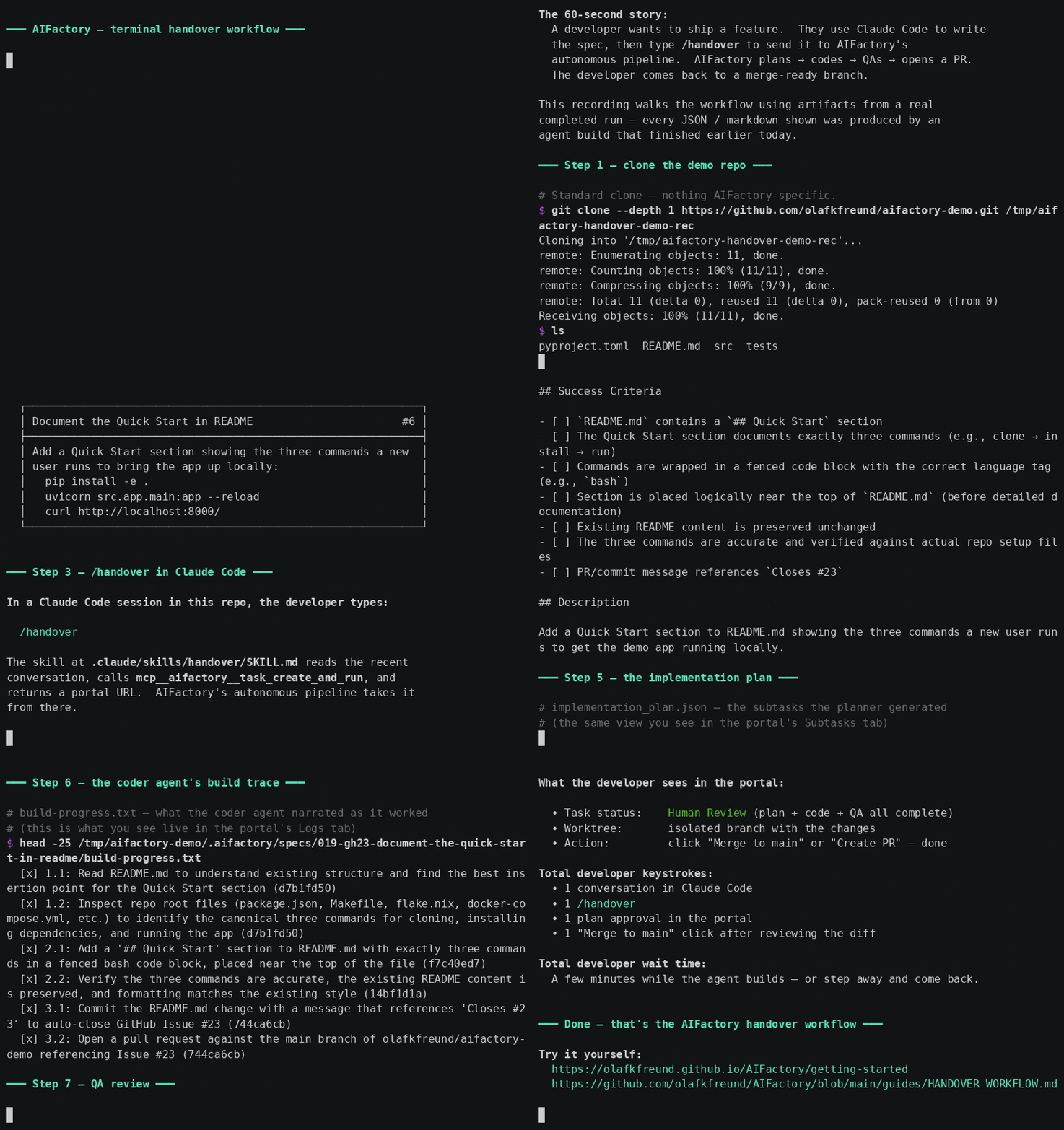
A 45-second terminal walkthrough of the /handover workflow: clone the demo repo, file a GitHub issue, type /handover in Claude Code, AIFactory’s planner → coder → QA pipeline lands at a merge-ready branch. Every artifact shown was produced by a real agent run — the recording compresses the timeline.
The repo also ships a scripted end-to-end demo that exercises the whole pipeline against a public sample repo:
./scripts/demo.sh
It seeds 3 GitHub issues, registers the demo repo with your portal, imports the issues as backlog tasks, prompts you to drive Claude Code from the terminal, then kicks off an autonomous build — all in about 90 seconds. Pass --yolo to skip the Enter-prompts between steps.
Walkthrough with screenshots + browser-side video: Demo →
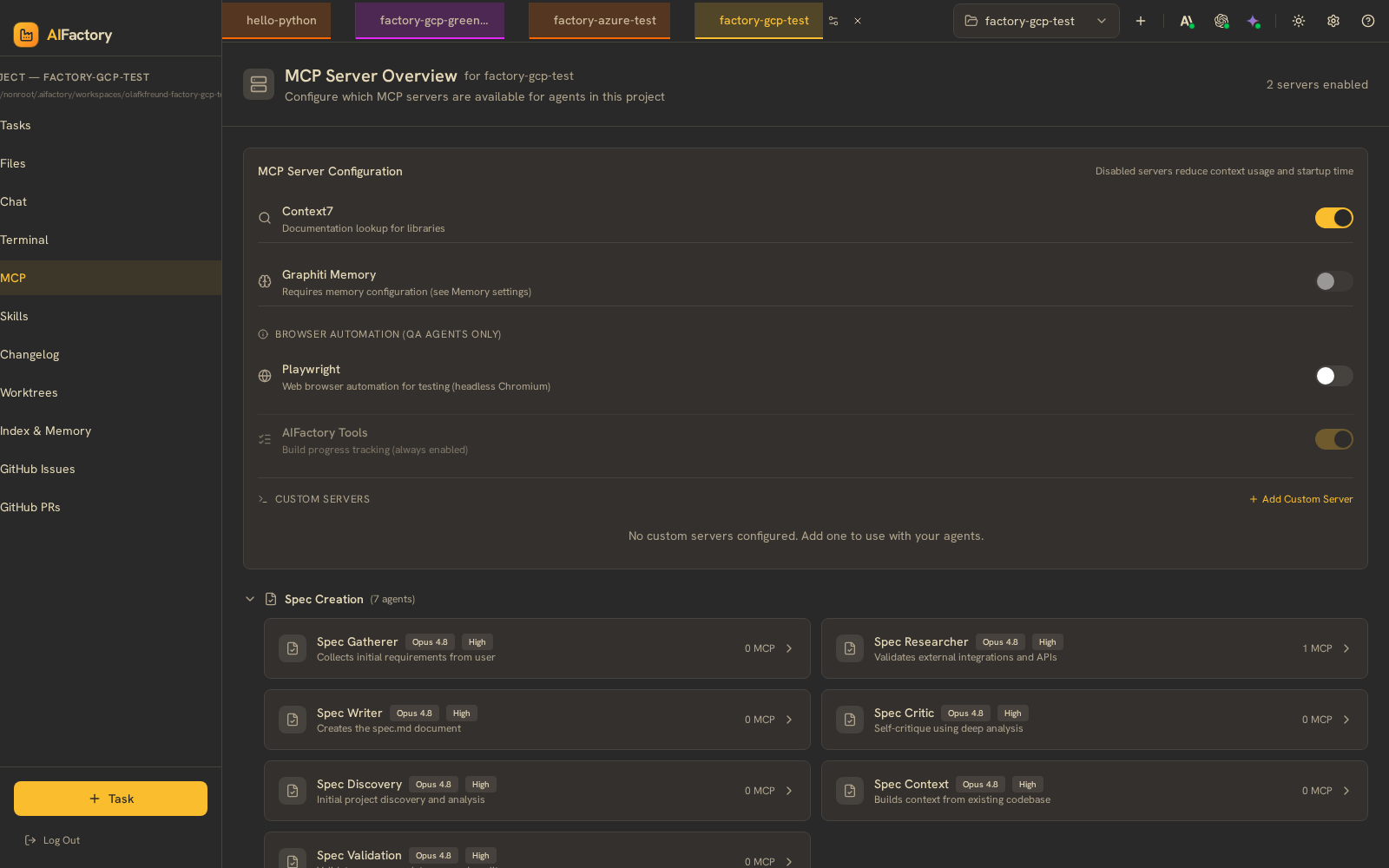
Screenshots
 |
 |
 |
 |
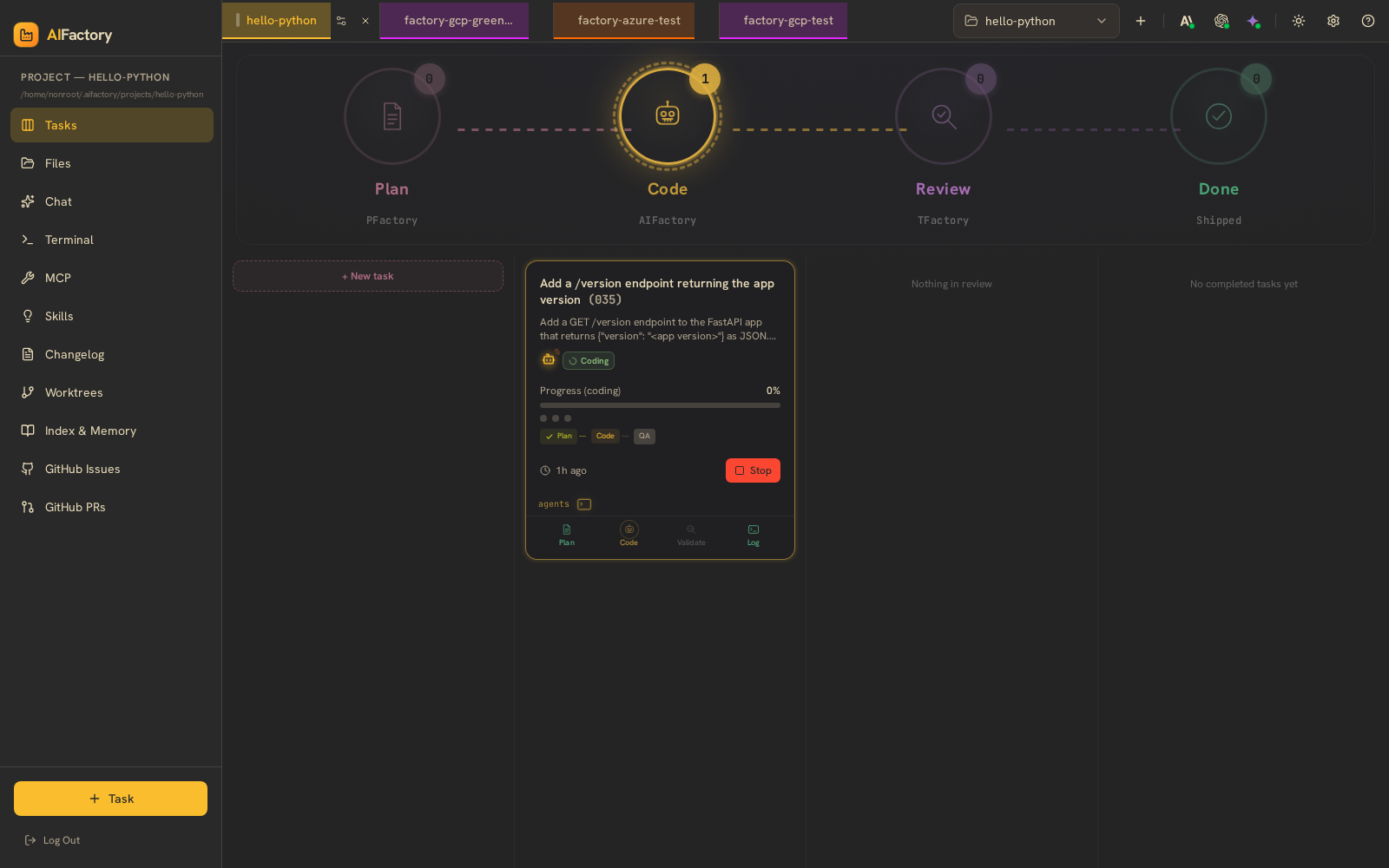
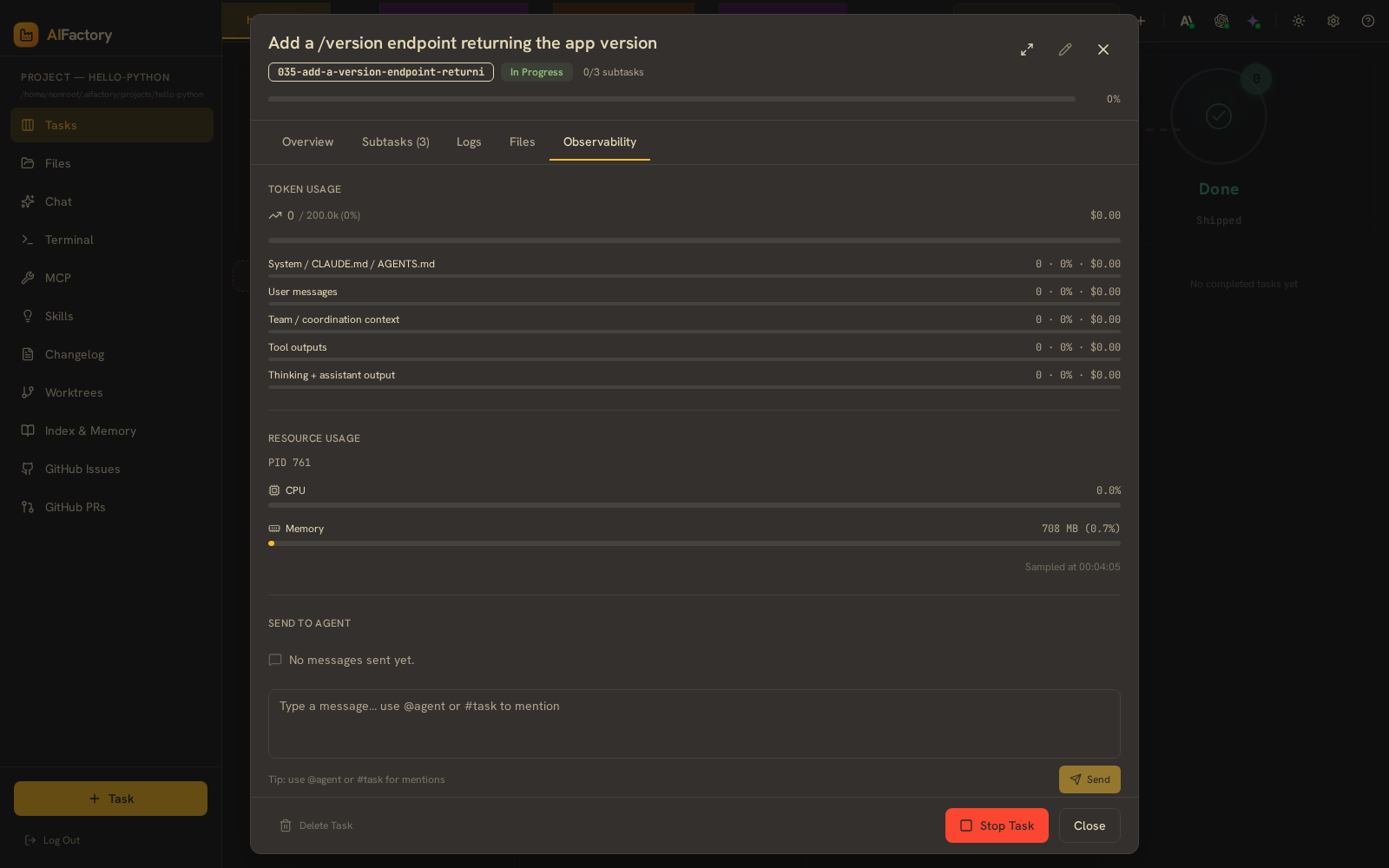
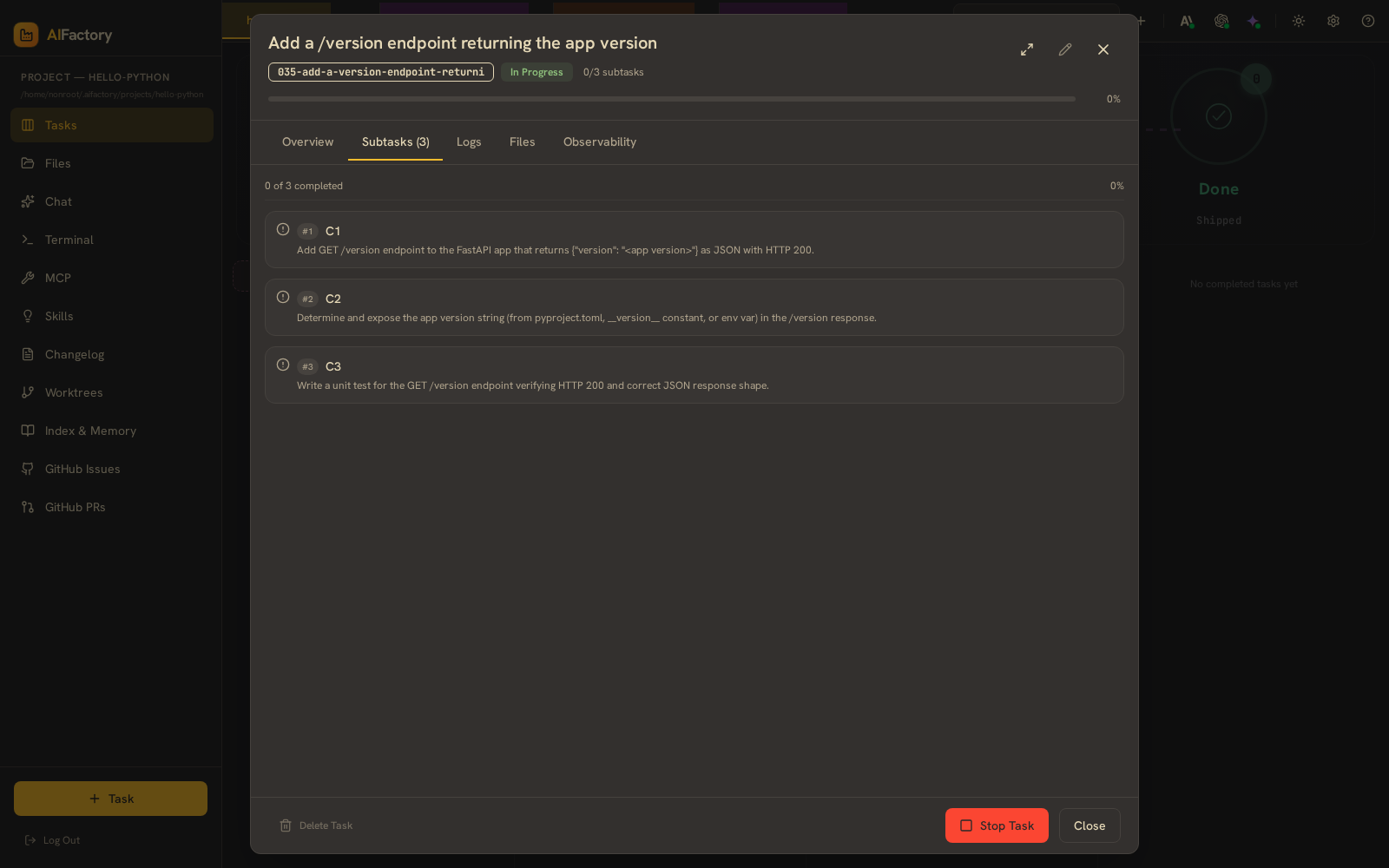
Screenshots are auto-captured by
scripts/capture-screenshots.tsfrom the live portal — refresh them withnpm -w apps/frontend-web run capture-screenshots. A fuller, captioned set lives in the Screenshot gallery.
Documentation
The full documentation lives at https://aifactory.freundcloud.com/:
- Getting Started — install + first task
- Demo — guided end-to-end walkthrough
- Concepts — spec-driven development, multi-provider routing, the rmux Live Console
- Architecture — agents, data flow, security model, Mermaid diagrams
- Wiki — FAQ, troubleshooting, glossary
- Compliance — SOC 2 evidence, GDPR, encryption-at-rest
Legacy guides (pre-2026-05-26 rewrite) are archived under docs-archive/2026-05-26/ and remain searchable in git history.
Stack
- Frontend — React 19 + Vite + xterm.js + Tailwind v4
- Web Server — FastAPI + WebSocket, Postgres + Alembic migrations
- Agent Runtime — Python 3.12, Claude Agent SDK, provider abstraction over Anthropic / OpenAI / Ollama / Gemini / Codex
- Deploy — Helm chart (
charts/aifactory/), distroless cosign-signed images, OIDC SSO, KMS-backed encryption at rest
Contributing
Branching: dev is the working branch. Branch from origin/dev, sign your commits (git commit -s), open PRs against dev. main is a release branch and only receives promotion merges.
git fetch origin
git checkout -b feat/my-feature origin/dev
git push -u origin feat/my-feature
gh pr create --base dev
CI runs ruff + pytest + frontend typecheck + Postgres acceptance + multiple compliance gates on every PR. Full guide: Contributing →
License
Dual-licensed under MIT or GPL-3.0 at your option — see LICENSE, LICENSE-MIT, and LICENSE-GPL.
Acknowledgements
Built with the Claude Agent SDK, FastAPI, Docusaurus, and rmux (terminal multiplexer fork in Rust, used for the Live Console).